Learn
Learn Your Subjects.
Explore every subject with Albert and the great teachers who shaped it.
Test
Test Yourself.
Put your knowledge to the test. Find what you know, then sharpen what needs work.
Study
October 2026
MTWTFSS
Tell Albert about a study session, test or exam.
Your Day
October 6
A focused plan, built around the work that moves you forward.
Physics
Waves
Waves
What Is a Wave?
You should be able to explain what a wave transfers, what moves locally, and why a wave is not a piece of matter travelling from one place to another.
A disturbance that travels
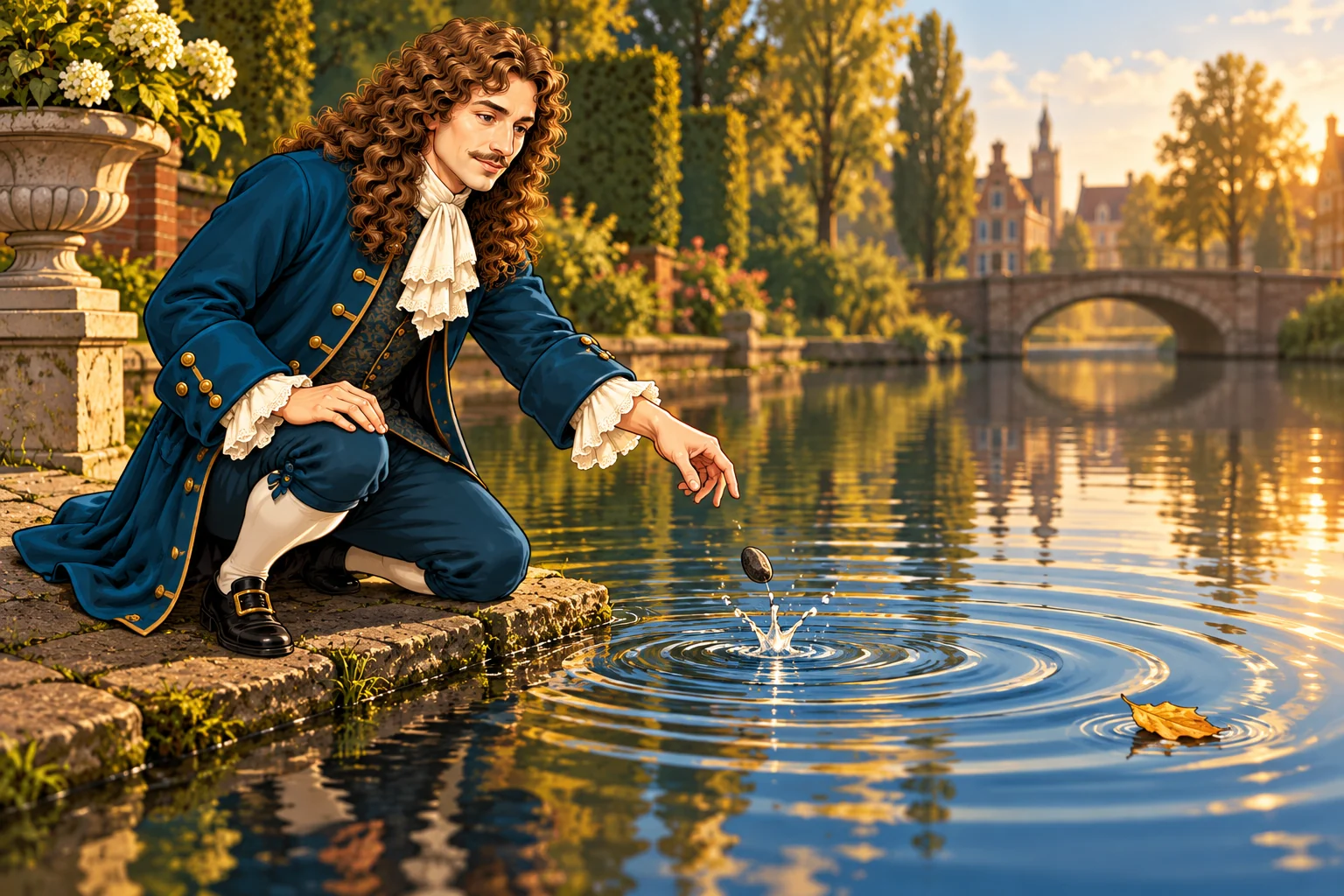
Drop a small stone into still water. The water surface is disturbed where the stone lands. Rings move away from that point and eventually reach the edge of the pond. The disturbance has travelled, and it has carried energy with it. Yet the water nearest the stone has not simply travelled in one long journey to the edge.
A wave is a travelling disturbance that transfers energy from place to place. A wave can transfer energy without carrying matter from the source to the destination. This is the central idea behind every wave topic.
A mechanical wave needs a medium. A medium is a material whose particles can respond to a disturbance and pass it on. A rope, water, air and the Earth are all media. Waves on a rope, water waves, sound and seismic waves are mechanical waves.
What actually passes the energy on
The transfer is not magic. A part of a medium is displaced from its normal position. A restoring effect pulls or pushes it back towards that position. While it is moving, it affects the neighbouring part of the medium. That neighbouring part is displaced in turn. The chain continues and the disturbance travels.
On a stretched rope, tension provides the restoring force. Pull one end upward and release it. The displaced section is pulled back by the tension, while also pulling the next section upward. In air, sound works differently. A vibrating object squeezes nearby air, making a region of high pressure. That compression pushes on the next region of air. The compression and the following low pressure region move outward as sound.
The exact mechanism changes from one medium to another, but the pattern is the same. Each part gives energy to the next part while remaining close to its own position.
Energy moves while matter moves locally
Place a leaf on the surface of the pond. As a ripple arrives, the leaf rises and falls. It can also move a little because real water has currents, wind and drag from the original splash. It does not travel across the pond with one particular ripple.
This is different from a current in a river. A current gives the water an overall movement downstream. A wave is an organised disturbance moving through the water. The medium may be displaced, but there is no overall transport of the same material from the source to the distant shore.
Oscillation, equilibrium and wave trains
Oscillation means repeated motion around an equilibrium position. The equilibrium position is the undisturbed position. A cork floating on calm water has an equilibrium height. A rope segment at rest has an equilibrium line. An air particle in still air has an equilibrium spacing from its neighbours.
A single disturbance is called a pulse. One flick of a rope makes one pulse. A source that vibrates repeatedly makes a continuous sequence of pulses called a wave train. The regularity of that vibration becomes important later when frequency and period are introduced.
A stadium wave is a useful model. Each person stands and sits near the same seat. The pattern moves around the stadium, but people do not run around the arena. A stadium wave is not a perfect physical model because people choose when to stand. It is still excellent for separating local motion from the motion of the pattern.
Water waves are a useful model with limits
For school physics, surface water waves are treated as transverse waves. The water surface moves mainly up and down while the wave travels across the surface. This is the correct model to use when classifying the wave in an exam.
Real water motion is more detailed. Near the surface, water particles often move in small circular or elliptical paths. They move a little forward and upward, then backward and downward. The wave still progresses across the water while individual particles remain close to where they began. The familiar smooth curve shows the shape of the water surface at one instant. It is not the path followed by one water particle.
Why ripples fade
Ripples become smaller as they spread. Their energy is shared around an ever larger circle, so less energy reaches each metre of the wavefront. Some energy is also transferred to the surroundings as heating because of friction and viscosity in the water.
This is called damping. Damping does not mean energy has disappeared. It means that energy has been spread out or transferred into less obvious forms, especially thermal energy. The same idea explains why sound becomes quieter with distance and why a vibrating guitar string gradually stops moving.
Mechanical waves and electromagnetic waves
Sound cannot travel through a vacuum because there are no particles to compress and spread out. Sound must have a medium.
Light is an electromagnetic wave. It is made from changing electric and magnetic fields and does not need a material medium. Light from the Sun crosses the near vacuum of space before reaching Earth. Both sound and light transfer energy, but their mechanisms are different.
How a wave can make something happen
Energy carried by a wave can produce an effect. Water waves can rock a boat. Sound waves can make an eardrum vibrate. Light can warm a surface or release electrical energy in a solar cell.
For waves of the same type in the same medium, a greater amplitude usually means more energy is being transferred. Amplitude is the greatest displacement from equilibrium. A larger amplitude does not automatically mean a larger speed. Amplitude, frequency, wavelength and wave speed are separate quantities, even though they are connected later by the wave equation.
One final model
A wave is an organised pattern of disturbance and energy transfer. It is not a solid object travelling through a medium. This also explains why two ripples can cross. In ordinary conditions, their displacements combine briefly, then each ripple continues. This later idea is called superposition.
Talk to Albert about school, study or life in general.
Aiza Ali
Age 14
Cambridge, United Kingdom
Perse Upper School
Year 9